
Newsroom
Commercial and industrial energy storage projects have different requirements. A factory may need battery storage for peak shaving, while a commercial building may prioritize backup power. Solar-plus-storage projects need sufficient battery capacity to store excess PV generation and use it when required.
A fixed battery configuration may not meet all these requirements.
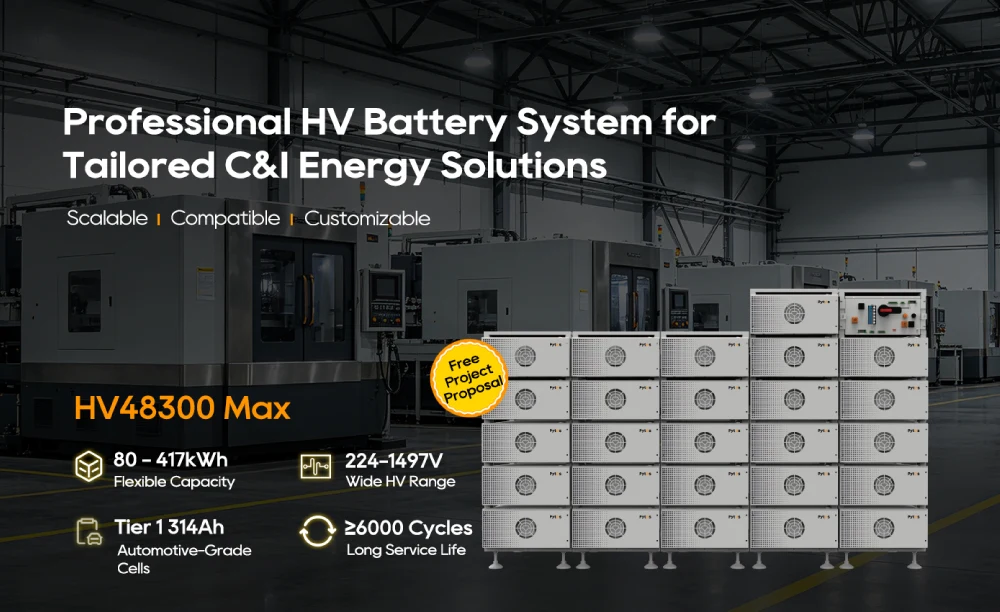
The Pytes HV48300 MAX addresses this challenge through a modular high-voltage battery design. With a system capacity range of 80–417kWh, multiple battery string configurations, and support for MWh-level expansion, it can be configured for different commercial and industrial energy storage projects.
Not every commercial or industrial project requires the same amount of energy storage. Battery capacity needs to match electricity consumption, expected operating requirements, and the project's investment budget.
The HV48300 MAX uses modular battery units, allowing the system to be configured according to project requirements.
Smaller commercial projects can use configurations toward the lower end of its capacity range, while factories and larger industrial facilities can deploy more battery modules to increase total storage capacity.
With a configurable system capacity of 80–417kWh, the solution accommodates different storage requirements within the same battery platform.
This modular approach also gives project developers more flexibility when planning initial investments and future capacity requirements.
Battery voltage is an important consideration when selecting an energy storage system. Different inverters and project designs may require different DC voltage ranges.
The HV48300 MAX supports multiple battery string configurations. Its BCU controller has a working voltage range of 224–1497V, providing flexibility for different system designs.
The universal mounting structure accommodates various inverter models, helping installers adapt the battery system to different inverter configurations.
This flexibility allows project developers to select suitable battery string arrangements according to inverter specifications and system requirements.
Different energy storage applications place different demands on battery systems. The modular design of the HV48300 MAX supports several common C&I applications.
Factories and commercial facilities may experience high electricity demand during certain operating periods. Battery storage can charge during off-peak periods and discharge during peak-demand periods, depending on the electricity tariff and energy management strategy.
The HV48300 MAX allows project developers to configure storage capacity according to facility load profiles and peak-shaving requirements.
For facilities that need additional power security, battery storage can supply electricity to designated loads when grid power is interrupted, provided the inverter and overall system are designed to support backup operation.
The required battery capacity depends on critical loads, expected backup duration, and power requirements.
Commercial solar installations may generate surplus electricity during the daytime, while building consumption and EV charging demand vary throughout the day.
Combining PV generation, battery storage, and charging infrastructure allows surplus solar energy to be stored and used when needed.
The HV48300 MAX supports this integrated application through configurable battery capacity and modular system design.
Some commercial and industrial projects experience increasing electricity consumption as production lines expand or additional equipment is installed.
The HV48300 MAX adopts a standardized modular design that supports expansion to MWh-level capacity for larger industrial and commercial applications.
This allows project developers to plan storage systems around current requirements while considering future expansion.
Rather than selecting an oversized system at the beginning, developers can evaluate the appropriate configuration based on project demand and expansion plans.