
Newsroom
For commercial and industrial facilities, energy management involves more than simply meeting daily electricity demand. Changes in grid conditions, peak electricity demand, electricity costs, and the timing of solar generation can all affect how energy is used.
A battery energy storage system can give businesses more flexibility by storing electricity when it is available and supplying stored energy when needed. A scalable high-voltage battery system is particularly useful for projects with changing capacity and voltage requirements.
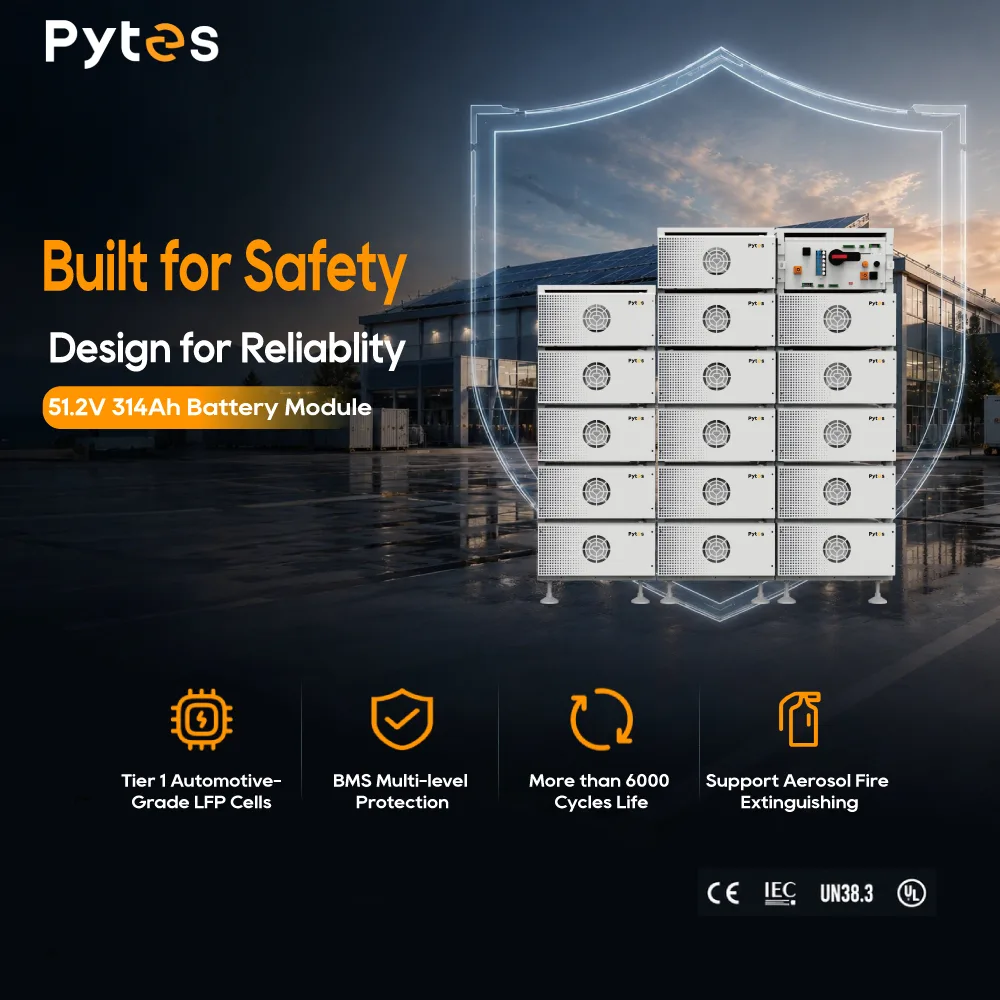
The HV48300 Max from PYTES is designed for commercial and industrial energy storage applications. Its modular architecture supports flexible system configurations and applications including industrial and commercial peak shaving, backup power, and PV-storage-charging integration.
Grid electricity demand can change throughout the day as facility loads rise and fall. For commercial and industrial users, this makes energy scheduling and consumption management more important.
Energy storage adds another option to the energy system by allowing electricity to be stored and used later. Instead of relying entirely on electricity directly from the grid at every moment, businesses can use stored energy as part of their overall energy management strategy.
The HV48300 Max has a wide system operating voltage range of 224V to 1497V. Its modular design allows the battery system to be configured according to different project requirements. The system supports multiple battery string configurations, providing flexibility for projects with different voltage and capacity requirements.
This makes the system suitable for commercial and industrial projects where energy storage requirements vary between applications.
Electricity consumption is often uneven throughout the day. Commercial and industrial facilities may experience periods of higher demand, making peak shaving an important energy management strategy.
Energy storage can support peak shaving by storing electricity during suitable periods and supplying stored energy during periods of higher demand. This gives businesses more control over when stored energy is used and when electricity is drawn directly from the grid.
The HV48300 Max is specifically designed for industrial and commercial peak shaving. Its standardized modular architecture allows the system to be configured for different project requirements while supporting scalable deployment.
For facilities focused on managing electricity consumption and peak demand, this type of battery architecture can be integrated into a broader energy management system.
Commercial and industrial facilities can have different electricity requirements depending on their equipment, production processes, and operating schedules. A scalable energy storage system can provide additional stored energy when required.
The HV48300 Max uses 314Ah LFP battery cells. Each BMU has a nominal energy of 16.076kWh, with a continuous charging and discharging current of 157A DC. The system supports 5 to 26 BMUs, allowing the total system capacity to be configured according to project requirements.
Scale seamlessly to MWh-level capacity with our modular battery system for industrial-scale applications. A single BCU supports up to 26 BMUs (417kWh), while multiple BCU units can be paralleled to achieve MWh-level capacity for larger projects. The free-stacking, cabinet-free design simplifies installation and reduces civil works.
Solar generation depends on sunlight availability, while commercial and industrial electricity demand may occur at different times. This can create a mismatch between when solar power is generated and when electricity is consumed.
Battery storage can help address this mismatch by storing available energy for later use. In a PV-storage-charging configuration, solar generation, battery storage, and charging infrastructure can be incorporated into a coordinated energy system.
The HV48300 Max supports PV-storage-charging integration, making it suitable for projects that combine photovoltaic generation with battery storage and charging infrastructure.
By storing solar energy for later use, businesses can make greater use of available renewable generation instead of relying only on the timing of solar production.
Commercial and industrial projects do not all have the same energy storage requirements. A factory, commercial building, charging facility, or PV-storage project may require a different combination of capacity, voltage, and inverter configuration.
The HV48300 Max addresses these requirements through its modular design. Multiple battery string configurations support a wide range of operating voltages, while the universal mounting structure accommodates various inverter models. Its simple bracket design and free-stacking structure are also intended to reduce installation time, labor, and cost.
The system uses independent fan cooling for each module and does not require liquid cooling circuits. According to the product specifications, this simple structure is designed to reduce long-term maintenance requirements and civil work costs.
Safety and service life are important considerations for commercial and industrial battery energy storage systems.
The HV48300 Max uses Tier 1 314Ah automotive-grade LFP cells and incorporates multi-level BMS monitoring and protection. It also supports aerosol fire extinguishing.
The HV48300 Max offers a cycle life of ≥6,000 cycles under the stated test conditions. It complies with certifications and standards including UL9540, UL9540A, UL1973, UL60730, UN38.3, IEC62619, IEC63056, IEC60730, IEC62477, IEC62040, CE EMC, and ECM.
These specifications provide a basis for evaluating the HV48300 Max for long-term commercial and industrial energy storage projects.
Grid electricity management, peak demand, high energy consumption, and solar integration are closely connected in many commercial and industrial projects. Battery storage can give businesses greater flexibility in how electricity is stored and used.
The HV48300 Max by PYTES combines high-voltage architecture, modular battery configuration, LFP technology, and support for industrial and commercial peak shaving, backup power, and PV-storage-charging integration. A single BCU supports up to 26 BMUs, delivering system capacity from 80kWh to 417kWh, while multiple BCU units can be paralleled for MWh-level expansion.
For C&I energy storage projects that require flexible capacity and voltage configurations, the HV48300 Max provides a modular approach to energy storage deployment and system integration.