
Newsroom
A 16kWh battery can provide substantial storage for a residential solar system, but whether it is enough depends on the home's electricity consumption, solar generation, and backup requirements.
The Pytes V16 provides 16.07kWh of nominal energy and is designed for residential and light commercial solar and backup applications.
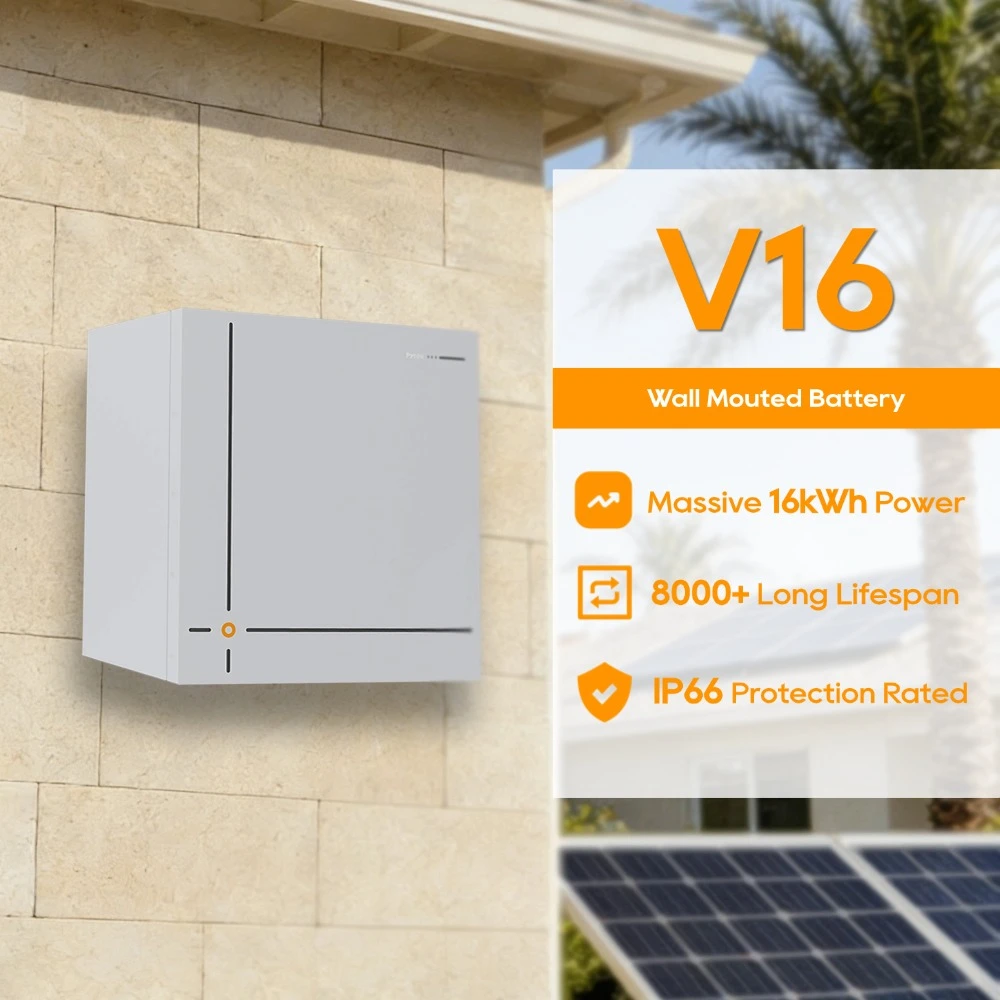
The V16 stores 16.07kWh of nominal energy. In simple terms, a 2kW load would consume about 2kWh per hour, so 16kWh could theoretically support that load for around eight hours under ideal conditions.
Actual runtime depends on the connected loads, inverter efficiency, battery state of charge, and operating conditions.
This makes the home's actual electricity consumption more important than the battery's capacity rating alone. For a household with modest consumption, 16kWh may provide more than enough storage, offering ample backup headroom without daily full utilization being a necessity. For a higher-consumption home, it's worth evaluating whether the daily usage aligns with the available capacity—and if not, additional storage can be added.
For a solar-plus-storage system, battery capacity selection should be aligned with the household's actual solar generation and consumption patterns.
During the day, excess solar power charges the battery; at night or on overcast days, the stored energy is discharged for household use. Whether 16kWh is "enough" depends on the balance between solar generation and electricity consumption:
For households with average daily consumption of 10–15kWh and sufficient excess solar production, 16kWh typically covers most evening-to-morning usage, achieving a high self-consumption rate.
For lower-consumption households, the battery may not be fully depleted—this indicates the storage demand is modest, and 16kWh serves as a capacity-rich configuration that provides more generous backup headroom.
For households with larger PV arrays generating surplus energy well beyond 16kWh of storage capacity, the actual demand exceeds what a single battery can handle—in this case, a multi-battery parallel configuration would be the appropriate solution.
Yes. A battery needs sufficient output power as well as sufficient energy capacity.
The V16 has a recommended discharge power of 7.68kW and a maximum discharge power of 10.24kW. This specification determines how much power the battery can deliver at a given time, while the 16.07kWh capacity determines how much energy it can store.
For a home with higher simultaneous loads, both figures should be considered when sizing the battery and inverter. Taking the V16 as an example, its power and capacity parameters offer strong compatibility with a wide range of residential applications.
Backup requirements vary considerably between households.
If the battery is used to support selected loads during a power outage, 16kWh may provide substantial backup energy. If the system is expected to support a larger number of loads for an extended period, more capacity may be needed.
The calculation should start with two figures:
Power demand: how much power the backup loads require at the same time.
Energy demand: how much electricity those loads will consume during the backup period.
The V16 is designed for residential and light commercial solar and backup applications, so its suitability depends on the specific load profile and system configuration.
If one V16 does not provide enough energy storage, multiple batteries can be used in a larger system.
For example, two V16 batteries provide 32.14kWh of combined nominal energy. This allows storage capacity to be increased when the home's electricity demand or backup requirements are higher.
The required number of batteries should be determined from actual electricity consumption, solar generation, backup requirements, and inverter compatibility.
Four factors are particularly important:
Review actual household electricity usage in kWh rather than estimating capacity from the number of appliances.
Check how much excess solar energy is available for battery charging. A battery should be sized according to the amount of energy that can realistically be stored and used.
Compare the home's highest expected power demand with the battery and inverter output.
Determine which loads need backup and how long they must remain operational. Supporting selected circuits requires less storage than attempting to power the entire home.
The V16 is a 16.07kWh low-voltage battery designed for residential and light commercial solar and backup systems. Its 7.68kW recommended discharge power and 10.24kW maximum discharge power make output capability another important consideration alongside storage capacity.
For daily solar storage, the right question is whether the battery matches the home's surplus solar generation and electricity consumption. For backup, the required capacity depends on the loads and desired backup duration.
If those requirements exceed the capacity of one battery, multiple V16 units can be used to build a larger storage system.