
Newsroom
Residential energy storage projects often face a practical challenge: there may not be enough indoor space to accommodate a battery system. Garages, utility rooms, basements, and equipment rooms may already contain electrical panels, HVAC equipment, and other household systems. Installing a large battery indoors can make the layout more complicated and reduce the space available for other uses.
An outdoor-ready battery provides an alternative. Instead of trying to fit the energy storage system into an already crowded indoor area, homeowners and installers can consider suitable outdoor installation locations.
When indoor installation space is limited, moving the battery outdoors can simplify the overall system layout. This approach is particularly useful for homes where garages and utility rooms cannot accommodate large energy storage equipment.
However, outdoor installation requires a battery designed to handle environmental exposure. Ordinary indoor batteries may need additional protective enclosures, increasing installation complexity and taking up more space.
image
The Pytes V16 addresses this requirement with an IP66-rated enclosure that provides protection against dust and water. Its outdoor-ready design allows installers to consider suitable exterior locations without relying on an additional protective cabinet.
Limited space does not necessarily mean homeowners must compromise on energy storage capacity.
Using multiple smaller batteries can increase the number of installation points, wiring connections, and space requirements. A higher-capacity battery can help simplify the system configuration.
The Pytes V16 offers 16.07kWh of nominal energy, with a recommended discharge power of 7.68kW and a maximum of 10.24kW. Its 51.2V LFP architecture makes it suitable for residential solar storage and backup applications.
For projects with relatively high energy demands but limited installation space, one V16 unit can provide substantial storage capacity while reducing the need to arrange multiple battery units in a confined area.
Every property has different installation conditions. Some have limited wall space, while others have suitable ground-level areas for energy storage equipment.
The Pytes V16 supports both wall-mounted and ground-mounted installation, giving installers more flexibility when planning the system layout. This makes it easier to adapt the installation to available space rather than redesigning the entire energy storage arrangement around a fixed mounting method.
Its dimensions of 700 × 671 × 260 mm also provide installers with specific measurements for evaluating potential installation locations before deployment.
Moving a battery outdoors solves the indoor space problem, but it also introduces environmental considerations such as rain, dust, and low temperatures.
The Pytes V16 combines IP66-rated protection with an integrated heating pad to support outdoor operation. The heating system helps manage low-temperature conditions, while its LFP battery chemistry provides a suitable foundation for residential and small commercial energy storage.
The battery supports charging temperatures from 0°C to 55°C and discharging temperatures from -20°C to 55°C. These operating ranges give installers useful reference points when assessing whether an outdoor location is suitable.
A compact installation layout should not come at the expense of system safety.
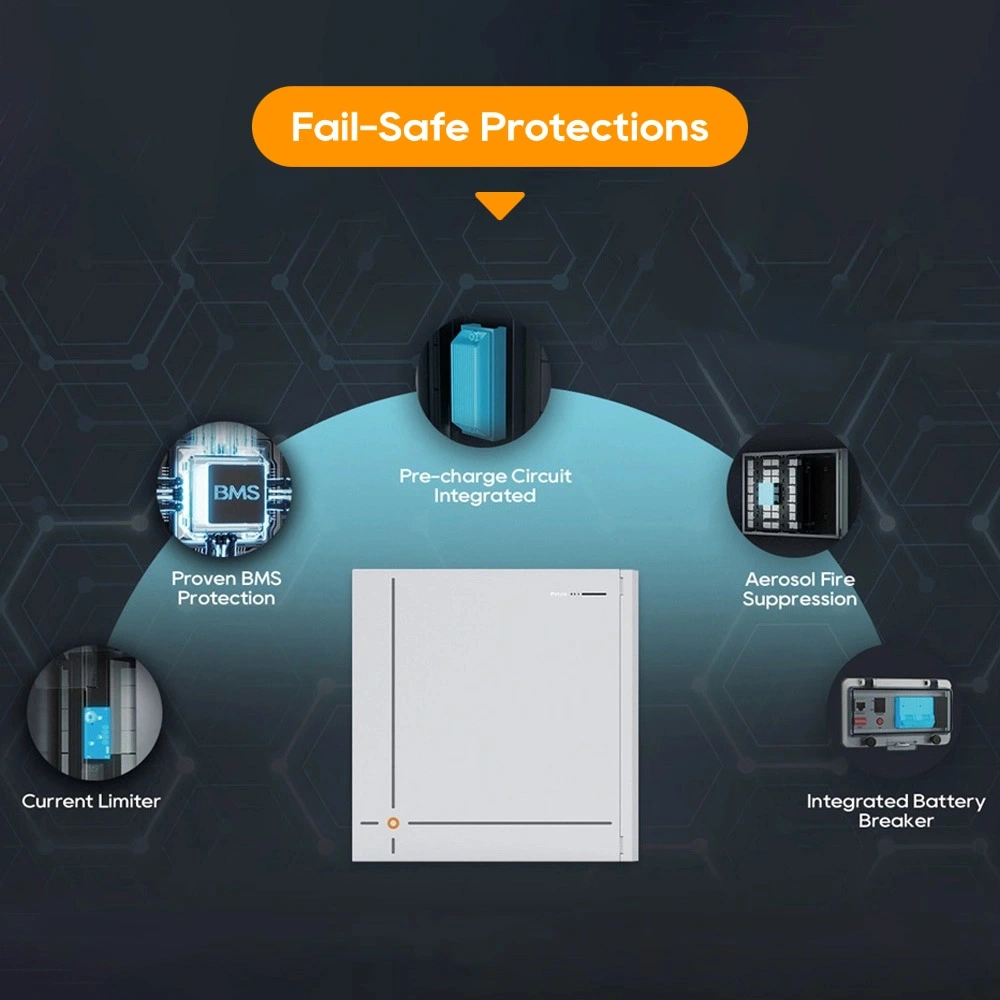
The Pytes V16 integrates several protective components, including a DC circuit breaker, pre-charge circuit, and aerosol fire suppression module. Integrating these components into the battery helps reduce the need for certain external components and keeps the overall system arrangement more organized.
It also supports RS485, CAN, WiFi, and dry contact communication, enabling closed-loop communication with most mainstream inverter brands. This helps installers integrate the battery into different residential energy storage configurations.