
Newsroom
HV48300 Max is designed around a high-voltage battery architecture that can support different energy storage requirements. Its battery modules use 314Ah LFP cells, with each module providing 16.07 kWh of nominal energy.
A single BCU can support up to 26 BMUs, providing approximately 417 kWh of battery capacity. Multiple BCUs can also be connected in parallel to support larger energy storage systems and expand capacity to the MWh level.
Rather than focusing only on battery capacity, HV48300 Max is designed as part of a complete energy storage solution. Its high-voltage architecture provides system integrators with a foundation for connecting the battery system with power conversion equipment and broader energy management systems.
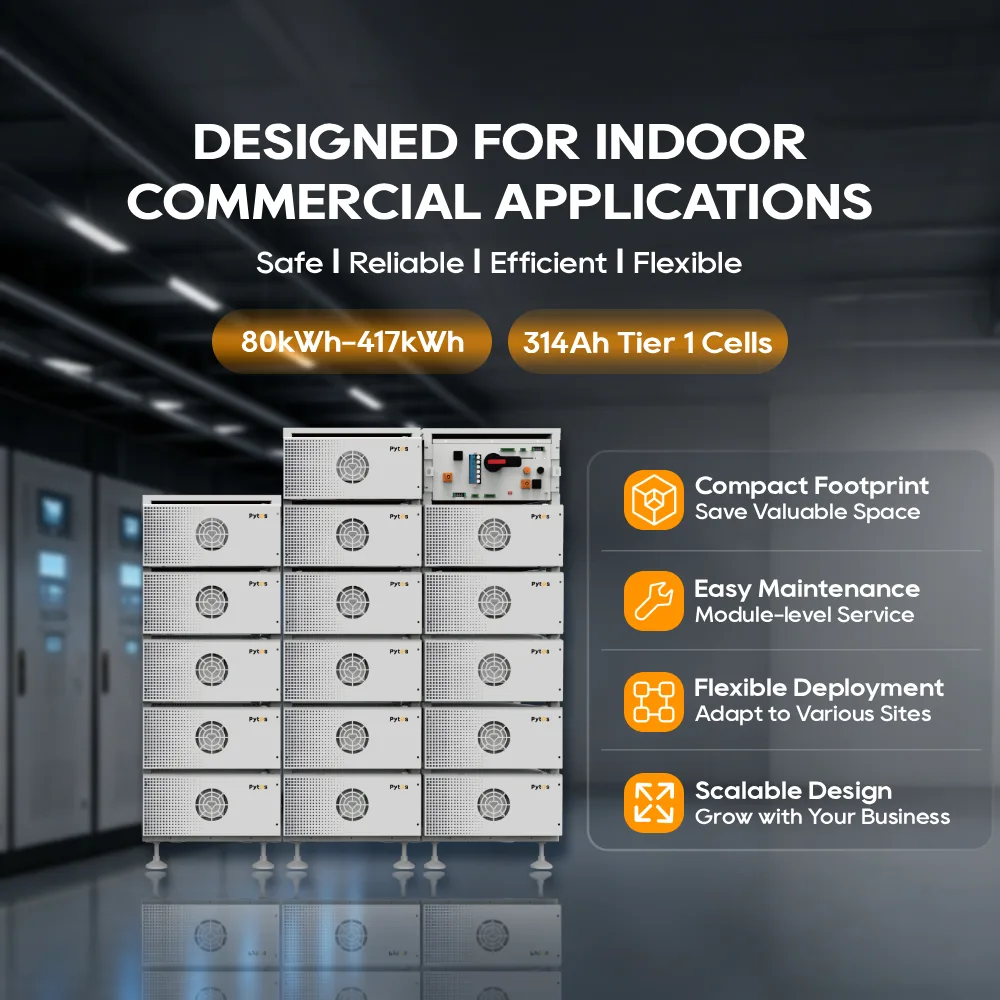
For commercial and industrial energy storage, battery chemistry plays an important role in long-term system operation. HV48300 Max uses Tier 1 automotive-grade LFP cells, combining the characteristics of LFP technology with an intelligent Battery Management System.
The BMS provides multi-level monitoring and protection during system operation. The system also incorporates aerosol fire suppression, adding an additional safety measure to the battery system.
With a specified cycle life of ≥8,000 cycles, HV48300 Max is designed to support long-term energy storage applications where stable operation and battery durability are important considerations.
Another practical advantage of HV48300 Max is its cabinet-free system structure. Instead of requiring the battery system to be installed inside a conventional fixed cabinet, the battery units can be freely stacked according to actual project requirements.
This gives installers greater freedom when planning the system layout. The battery configuration can be arranged around the available installation space and site conditions, making the system easier to adapt to different commercial and industrial environments.
The cabinet-free structure is especially useful when the installation area is limited or when the project has a non-standard layout. Rather than being restricted by a predefined cabinet footprint, installers can determine a more suitable arrangement for the battery units and make better use of the available space.
This design also supports faster deployment. The battery units can be arranged and stacked according to the planned system configuration, helping simplify installation planning and on-site deployment. The free-stacking, cabinet-free approach can also reduce restrictions associated with conventional cabinet-based installation.
The modular architecture also provides a straightforward path for future capacity expansion when additional energy storage is required, but the key value of this design is the freedom it provides during actual system installation and deployment.
Energy storage requirements can vary significantly from one project to another. Commercial buildings may focus on energy management and peak demand, while industrial facilities may require larger storage capacity and more flexible system configurations.
HV48300 Max can be used in applications such as:
Commercial and industrial energy storage
Peak demand management
Backup power
Solar-plus-storage systems
Distributed energy storage
Its scalable architecture allows system integrators to develop configurations around the specific requirements of each project instead of relying on one fixed battery configuration.
A battery system also needs to communicate effectively with the rest of the energy storage system. HV48300 Max supports CAN and RS485 communication, providing practical options for battery monitoring and system integration.
Combined with its high-voltage architecture and modular battery design, this makes HV48300 Max suitable for system integrators who need to coordinate battery capacity, electrical configuration, monitoring, and overall energy management.
For modern commercial and industrial energy storage projects, a battery solution needs to provide more than high capacity. It should also work with the realities of the installation site and the requirements of the complete energy storage system.
HV48300 Max combines LFP battery technology, intelligent battery management, high-voltage architecture, and a cabinet-free system design to provide a practical solution for different energy storage applications.
Its ability to freely stack battery units according to project requirements and support faster deployment gives system integrators greater freedom during installation, while its scalable architecture leaves room for future energy storage needs.
With this balance of battery performance, safety, system integration, and practical deployment, Pytes HV48300 Max provides a flexible foundation for commercial and industrial energy storage projects.