
Newsroom
As residential and light commercial energy storage continues to develop, battery system architecture has become an important consideration when planning a solar energy storage project. Users may choose between a traditional modular battery system made up of multiple smaller battery units and a high-capacity battery such as the PYTES V16 Lite.
Both approaches can provide reliable energy storage, but they differ in capacity configuration, installation, space utilization, and system design. The V16 Lite is designed to provide substantial low-voltage energy storage in a compact and practical battery solution.
The main difference lies in how battery capacity is configured.
A modular battery system generally combines multiple smaller battery modules to reach the required storage capacity. This approach allows users to configure total capacity according to project requirements.
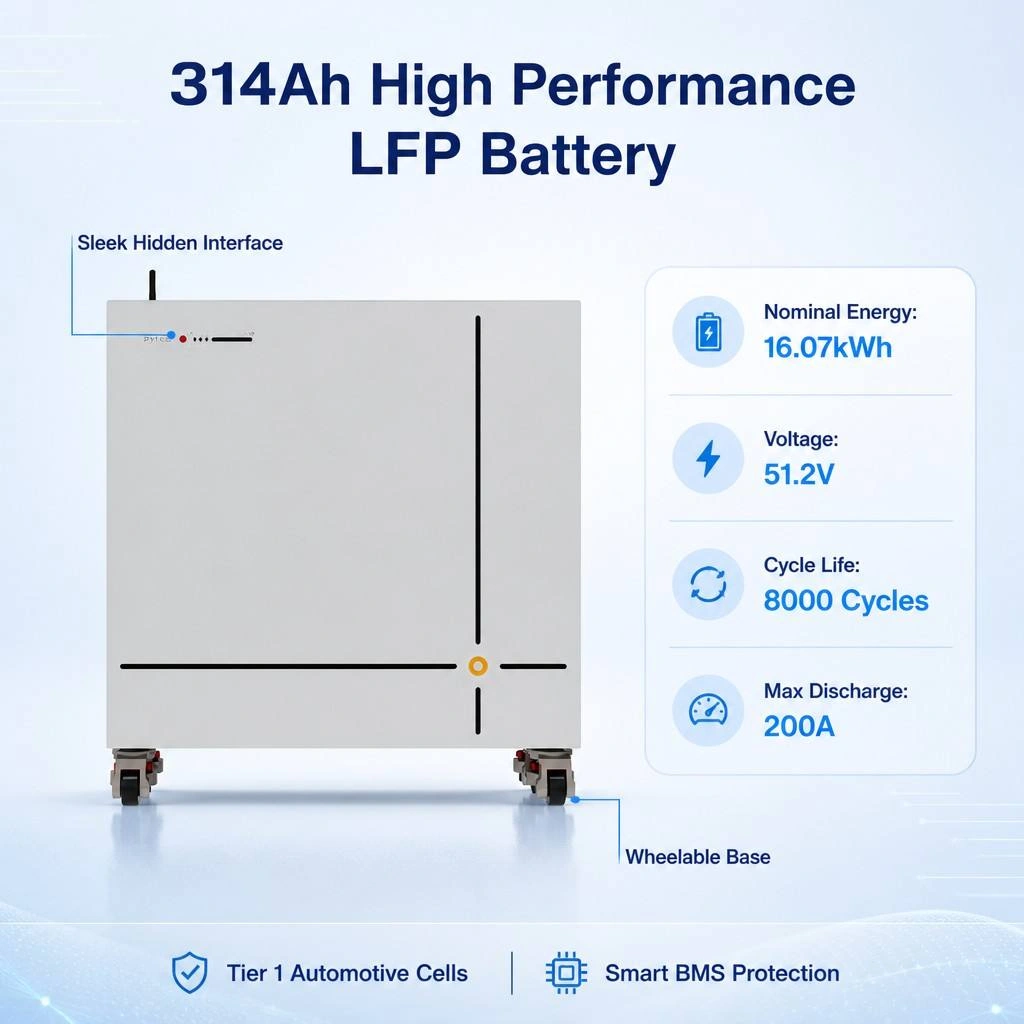
The V16 Lite takes a high-capacity single-unit approach, providing 16.07 kWh of nominal energy at a 51.2V nominal voltage. It also supports parallel connection of multiple units, but with a higher single-unit capacity, it is often sufficient on its own for households with lower power demand, while modular systems offer greater scalability when a single unit is not enough.
With a traditional modular battery system, installers can combine different numbers of battery modules according to the required system capacity. This can be useful when a project requires flexible capacity configuration.
The V16 Lite provides 16.07 kWh in one battery unit, allowing system designers to achieve substantial storage capacity without building the system entirely from smaller battery units.
For residential and light commercial projects that require relatively high storage capacity, this integrated approach reduces the number of batteries needed and provides a more straightforward battery configuration.
A modular system with multiple battery units may involve more individual units and corresponding installation connections.
The V16 Lite integrates a larger amount of energy storage into a single battery unit, helping create a more streamlined installation. Its compact dimensions of approximately 651.9 × 702.6 × 189.5 mm also make it easier to plan within suitable installation areas.
For installers, a high-capacity battery design can help simplify equipment arrangement and installation planning.
Available space is another important consideration for residential energy storage.
When multiple modular batteries are installed together, the overall footprint depends on the number of modules and the selected installation configuration.
The V16 Lite offers a compact form factor for a 16.07 kWh battery, with a depth of approximately 189.5 mm. This slim design can be advantageous for projects where installation space needs to be used efficiently.
Battery capacity is not the only factor to consider. Power capability is also important when the system needs to support different loads.
The V16 Lite provides 16.07 kWh nominal energy and supports a recommended charge and discharge current of 150A. Its maximum charge and discharge current can reach 200A, providing up to 10.24 kW under specified operating conditions.
When comparing the V16 Lite with modular battery systems, installers should therefore consider both storage capacity and the power requirements of the complete energy storage system.
The V16 Lite uses LFP battery chemistry and incorporates a battery management system for battery monitoring and operational management. It supports RS485, CAN, dry contact, and Wi-Fi communication, allowing integration with compatible energy storage equipment and monitoring solutions.
For modular battery systems, communication and compatibility can vary according to the battery modules, BMS, inverter, and system architecture. Checking compatibility between the major system components is therefore important during system design.
The V16 Lite can be considered when a project requires substantial low-voltage energy storage while maintaining a streamlined battery configuration.
Residential solar energy storage: The 16.07 kWh capacity provides substantial storage for managing solar generation and household electricity consumption.
Home backup: The V16 Lite can be integrated into suitable backup power systems to support household loads, depending on inverter configuration and system requirements.
Light commercial energy storage: The V16 Lite can also be considered for suitable light commercial energy storage applications where a high-capacity low-voltage battery is required.
Modular battery systems can be useful when flexible capacity configuration is required. However, when a project already needs substantial storage capacity, a high-capacity battery can provide a streamlined alternative to combining numerous smaller units.
The PYTES V16 Lite combines 16.07 kWh of nominal energy, low-voltage architecture, LFP battery chemistry, a compact design, and multiple communication interfaces in one battery unit.
For residential and light commercial energy storage projects, evaluating energy capacity, power demand, available space, inverter compatibility, and installation requirements together can help determine the appropriate battery architecture.