
Newsroom
2026 Industry Insight: How Energy Predictability is Redefining Commercial Competitiveness
1. Macro Trend: The Scaling of Africa’s Energy Storage Market
According to market tracking by BloombergNEF (BNEF), the African energy landscape has reached a pivotal inflection point. Following a record-breaking 945% surge in battery energy storage system (BESS) deployment in 2024, the market has transitioned into a phase of sustained scaling throughout 2025 and into early 2026.
This growth is increasingly decoupled from simple emergency backup needs. The Africa Solar Industry Association (AFSIA), in its Africa Solar Outlook 2026 report, notes that the pipeline for solar-plus-storage projects in development across the continent has reached an unprecedented 296 GW. This suggests that distributed energy systems are no longer viewed as peripheral supplements but as foundational infrastructure for industrial growth.
2. Shifting from Volatility to Energy Predictability
In major commercial and industrial (C&I) hubs such as Nigeria, South Africa, and Kenya, the transition is being accelerated by the urgent need for Energy Predictability.
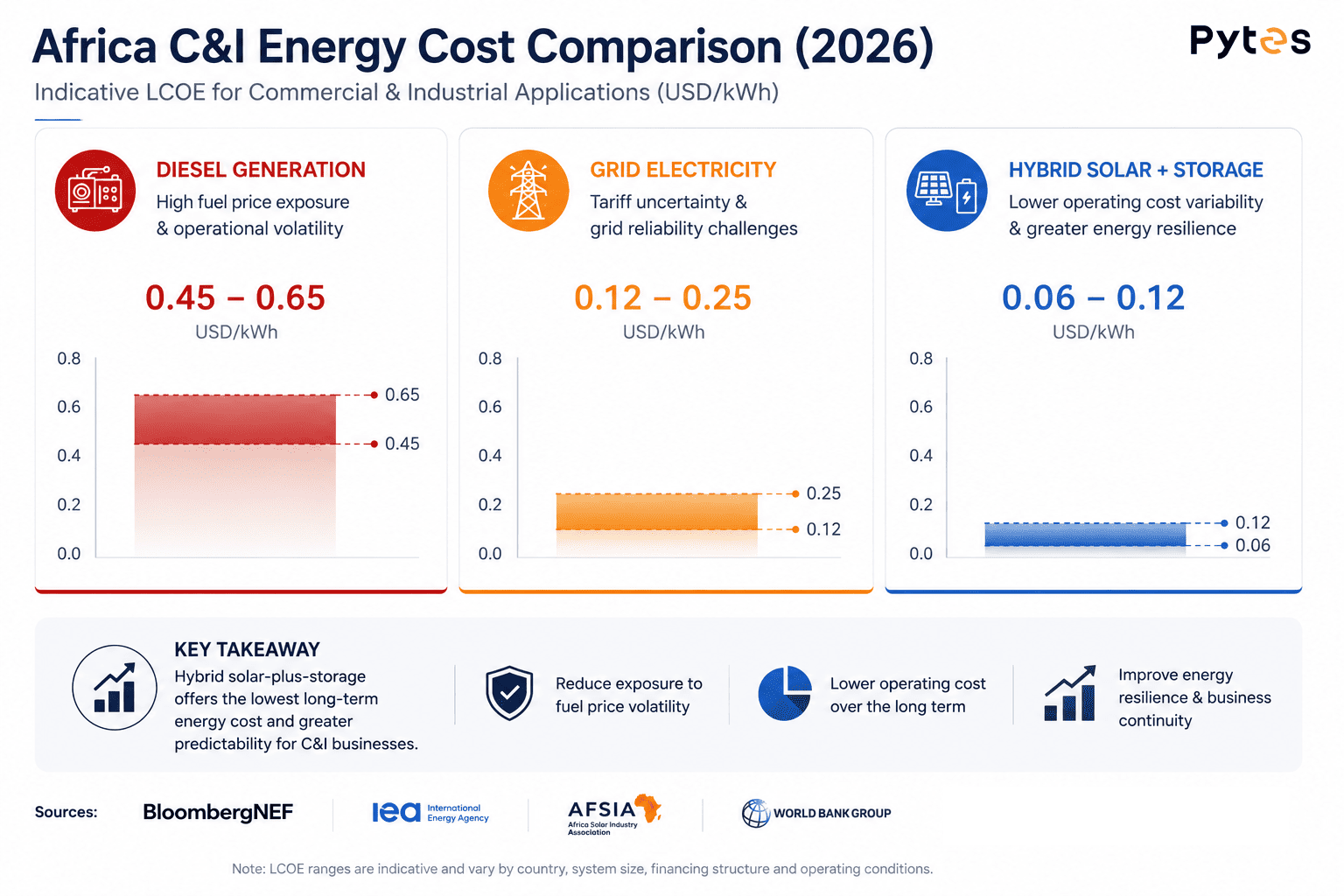
● Fuel Cost Pressures: Data from the Nigeria National Bureau of Statistics (NBS) and regional energy analysts indicate that following fuel subsidy reforms and currency fluctuations, the Levelized Cost of Electricity (LCOE) for private diesel generation approached $0.60/kWh by the end of 2025.
● Comparative Economic Advantage: In contrast, industry estimates from the International Energy Agency (IEA) and regional project trackers suggest that optimized commercial solar-plus-storage systems can achieve an LCOE in the range of $0.03–0.05/kWh.
● Strategic Reclassification: This 12-to-18-fold cost disparity is forcing a reclassification of energy on the corporate balance sheet. Rather than a volatile operational expense, energy is now a predictable asset. For sectors such as manufacturing, cold-chain logistics, and data centers, "Energy Resilience" has become a direct determinant of operational margins.
3. The Evolutionary Role of BESS: Infrastructure for Business Continuity
The traditional "Grid + Diesel" model is being replaced by sophisticated Hybrid Energy Storage Systems (Hybrid ESS). This evolution reflects a broader definition of Business Continuity among African C&I stakeholders:
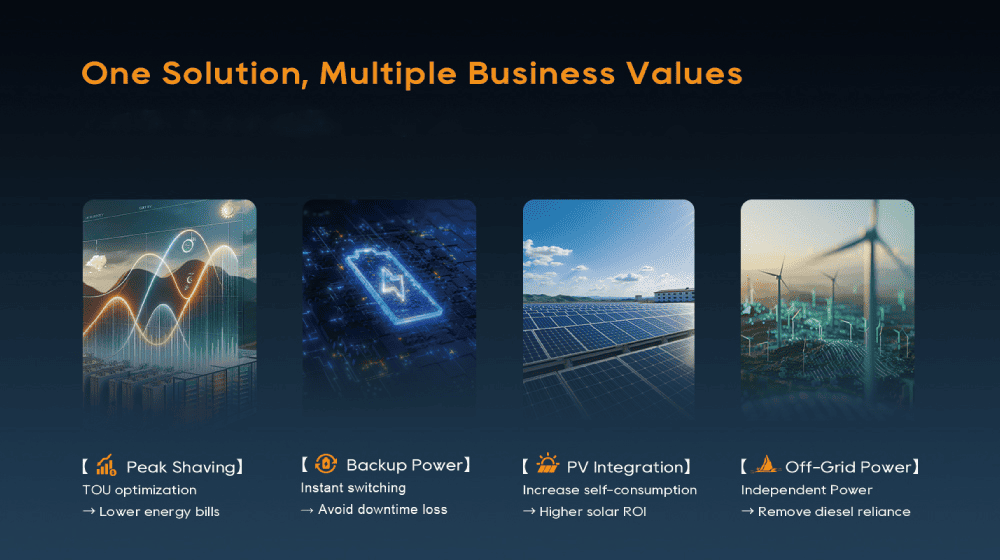
● Load Shifting & Peak Shaving: Utilizing BESS to store low-cost solar energy during the day for use during peak tariff periods or at night, effectively "locking in" energy rates for years to come.
● Microgrid Stability: In regions with severe grid instability, the storage system acts as the "heart" of a microgrid, coordinating multiple energy inputs to ensure 24/7 production uptime.
● Asset Optimization: By reducing the frequent cycling and low-load operation of diesel generators, integrated storage extends the maintenance cycles and lifespans of existing thermal assets.
4. Technical Adaptability in the African Operating Environment
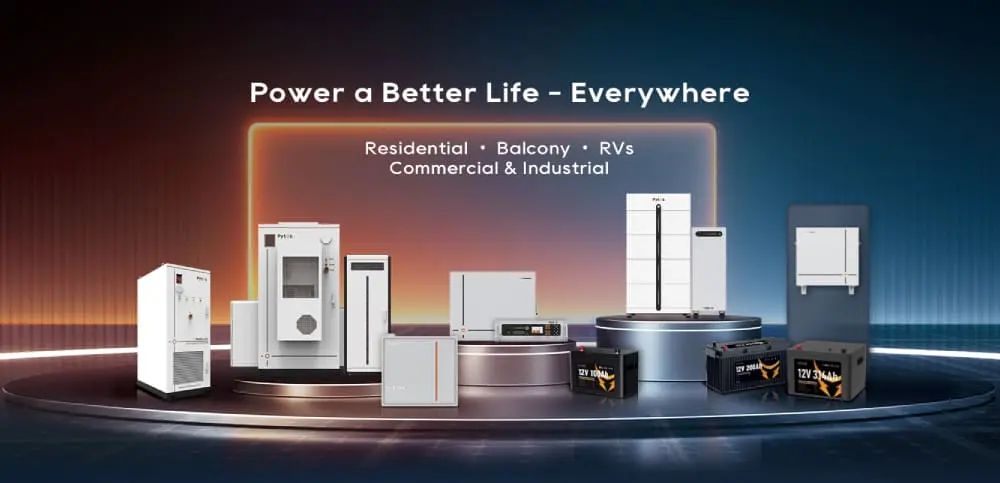
Project success in Africa depends heavily on the technical resilience of the storage chemistry and the support ecosystem. As a participant in the global energy storage market, Pytes has observed that C&I project bankability in the region is increasingly tied to three technical pillars:
● Safety and Thermal Stability: Lithium Iron Phosphate (LFP) has emerged as the preferred chemistry for the African climate due to its high thermal runaway threshold and long cycle life under high-ambient-temperature conditions.
● Scalability and Modular Design: To match the dynamic growth of African SMEs, modular high-voltage systems—such as the Pytes HV48300 series—allow enterprises to scale their energy capacity in alignment with their operational expansion.
● Interoperability and Local Support: Lowering the barrier to maintenance requires deep compatibility with global inverter standards (including Victron, SMA, and Deye). Pytes focuses on empowering local distribution and technical teams to ensure that systems are optimized for local grid characteristics and environmental stresses.
From all-in-one outdoor solutions like the Pi Station 261EX for remote mining to scalable platforms HV48300 MAX for urban commercial hubs, the focus is on providing a reliable technical backbone for critical facilities like hospitals, factories, and schools.
5. Conclusion: Resilience as a Competitive Advantage
As Africa’s energy transition matures, the "certainty" of power supply is becoming a new benchmark for corporate competitiveness. The shift from reactive backup power to proactive Energy Resilience infrastructure marks a significant milestone in the continent’s industrialization.
For business leaders and investors, deploying reliable storage to hedge against fuel volatility and grid instability is more than an operational upgrade—it is a strategic move to secure commercial certainty for the decade ahead.